
Why You're Missing Assignments in College
Assignment Tracker
College Tips
Tools
Productivity
Organizational
Jan 22, 2026
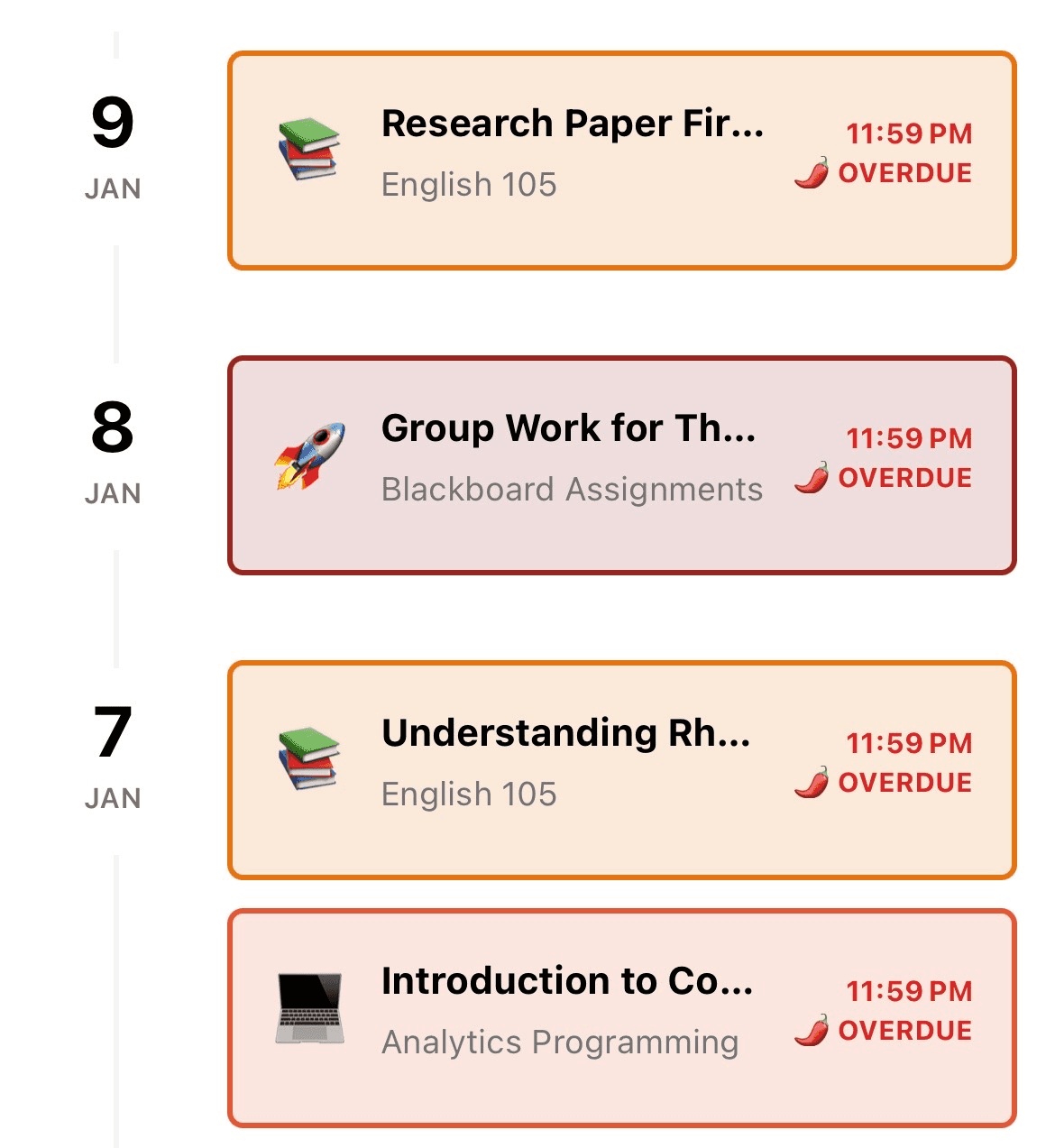
See every upcoming and overdue assignment in one place with Due Gooder.
Drowning in missing assignments? Don't worry - you're not alone .
Missing assignments can pile up fast, and that feeling of being stuck can paralyze you . The cycle gets tough - you miss assignments, feel anxious, skip classes, and end up with even more late work . This isn't about you failing. If you keep falling behind, it usually points to a bigger problem . Most schools don't deal very well with students' real-life challenges. You might be behind because you got sick, struggled with mental health, or just had too much on your plate - but there are ways to get back on track .
Your approach to handling these situations makes a difference. Do missing assignments hurt your grade? Yes - but you can limit the damage if you tackle it right. In this piece, we'll look at why students fall behind, how to take control of your schoolwork, and ways to catch up without exhausting yourself. We won't give you basic tips about time management. Instead, you'll get practical, understanding solutions that tackle your real challenges head by head.
Why Students Fall Behind on Assignments
Learning why students fall behind in their studies helps create solutions that work. Three main reasons explain why students miss deadlines and incomplete assignments.
Missing classes and falling out of routine
Missing classes affects students way beyond just missing the lecture. Research shows student absence rates can climb up to 40% [1]. College professors rarely keep track of attendance, unlike high school teachers. This makes it easy to develop a habit of skipping classes [2]. Each missed class means you'll miss important announcements about assignments and lose vital context needed to understand the course material.
Your whole academic schedule can fall apart without regular class attendance. This becomes a real challenge in college since you alone must keep track of all your coursework.
Underestimating workload and deadlines
Students often struggle with what educators call "the workload dilemma." College brings a radical alteration in expectations compared to high school. High school might ask for 15 hours of homework weekly, but college just needs much more - experts suggest you study three hours for each hour spent in class [3].
College deadlines also tend to pile up, creating intense periods where multiple outstanding assignments are due at once [4]. Students often say they feel "completely suffocated" by academic pressure [5], especially when professors think students have more time than they actually do.
Mental health and motivation issues
The connection between mental health and academic success might be the most overlooked reason. Nearly 90% of students say their mental health disrupts their studies or prevents them from completing assignments at some point [6]. These disruptions happen daily for one in ten students.
Students with stress, depression, and anxiety tend to perform worse academically [7]. It also doesn't help that specific challenges like procrastination (affecting 47% of students) and technology distractions (affecting 38%) directly get in the way of finishing work [6].
This creates a vicious cycle: past due assignments create more stress, which makes it harder to focus and complete work effectively. Meanwhile, motivation goes up and down, especially when the pile of makeup work seems overwhelming.
How to Regain Control Over Outstanding Assignments
Getting back on track with your schoolwork needs a step-by-step plan. Schools don't always give students good tools to track their work, so you'll need to create your own plan to catch up.
Make a complete list of past due assignments
You need a clear picture of what you haven't turned in yet to start catching up. An assignment master list will be your guide to getting back on track. Your list should include:
Assignment name and course
Original due date
Assignment type (quiz, homework, project)
Point value or weight
Any special notes about requirements
Many students don’t miss assignments because they’re lazy. They miss them because deadlines live in too many places.
Syllabi, Canvas announcements, email reminders, and calendar events rarely stay in sync. Even the most organized students fall behind when they’re manually tracking everything.
That’s why Due Gooder exists. Instead of asking you to build another system, Due Gooder automatically pulls assignments from your syllabus or LMS and keeps them in one place, so nothing slips through the cracks.
Email professors to ask about missing work
After you know what's missing, you'll need to talk to your professors. In stark comparison to this common fear, most professors actually like it when students reach out about incomplete assignments.
Write your email with a clear subject line, friendly greeting, honest explanation, and when you plan to turn it in. Let them know you're sorry about any hassle and thank them for their time. Don't skip the next class just because you missed work—professors usually want to help you succeed [8].
Use a calendar to set realistic deadlines
A calendar that's always up to date can cut down your stress about outstanding assignments by a lot [9]. College is different from high school - you need to plan time to do the work, not just mark due dates.
Put all your classes and study blocks in your calendar. Experts say you should schedule specific times to work on each past due assignment instead of just writing down when it's due [10]. This makes study time just as important as showing up to class.
Your calendar becomes your personal comeback plan that breaks down big backlogs into daily tasks. Setting aside time each week (like Sunday mornings) to plan helps you stay on track all semester [9].
Smart Strategies to Catch Up Without Burning Out
Academic catch-up work demands both balance and strategy. Students who lack a systematic approach risk falling into a burnout cycle that makes their academic situation worse. These proven methods will help you recover step by step without feeling overwhelmed.
Use the 2:1 ratio method
Teachers with 20 years of experience developed the 2:1 ratio as a proven catch-up strategy [11]. This method tackles a key challenge: managing current assignments while working through past due assignments. The process works through alternation:
Complete two current assignments
Finish one missing assignment
Return to two current assignments
Complete another overdue task
This pattern helps you stay current while steadily reducing your backlog of incomplete assignments.
Prioritize assignments linked to upcoming tests
Strategic prioritization becomes crucial when you have several outstanding assignments. You can try these approaches:
Time-based: Start with oldest assignments first
Deadline-based: Focus on assignments with soonest deadlines
Difficulty-based: Begin with simpler tasks for quick wins or tackle complex ones first
All the same, assignments tied to upcoming tests should take priority [11]. To cite an instance, when you have a calculus exam approaching, complete related worksheets first—you'll prepare for the test while reducing your backlog.
Temporarily reduce non-academic commitments
Catching up on work requires significant time—that's just reality. Creating space for academic recovery means scaling back other activities temporarily. You might need to:
Reduce work hours briefly
Limit social engagements
Request early dismissal from extracurriculars [11]
These reductions won't last forever. You can add activities back gradually once you catch up. If you keep falling behind despite your best efforts, so you might need to take a longer look at your overall commitments for better balance [11].
Most educational systems don't account for students' complex lives. These strategies help you handle that reality better.
Preventing Future Incomplete Assignments
The fastest way to stop missing assignments isn’t better motivation, it’s removing the need to remember deadlines at all.
In Due Gooder, assignments don’t disappear just because they weren’t completed. Overdue work stays visible, reminders continue, and your calendar updates automatically. That’s how students stay ahead even during busy weeks.
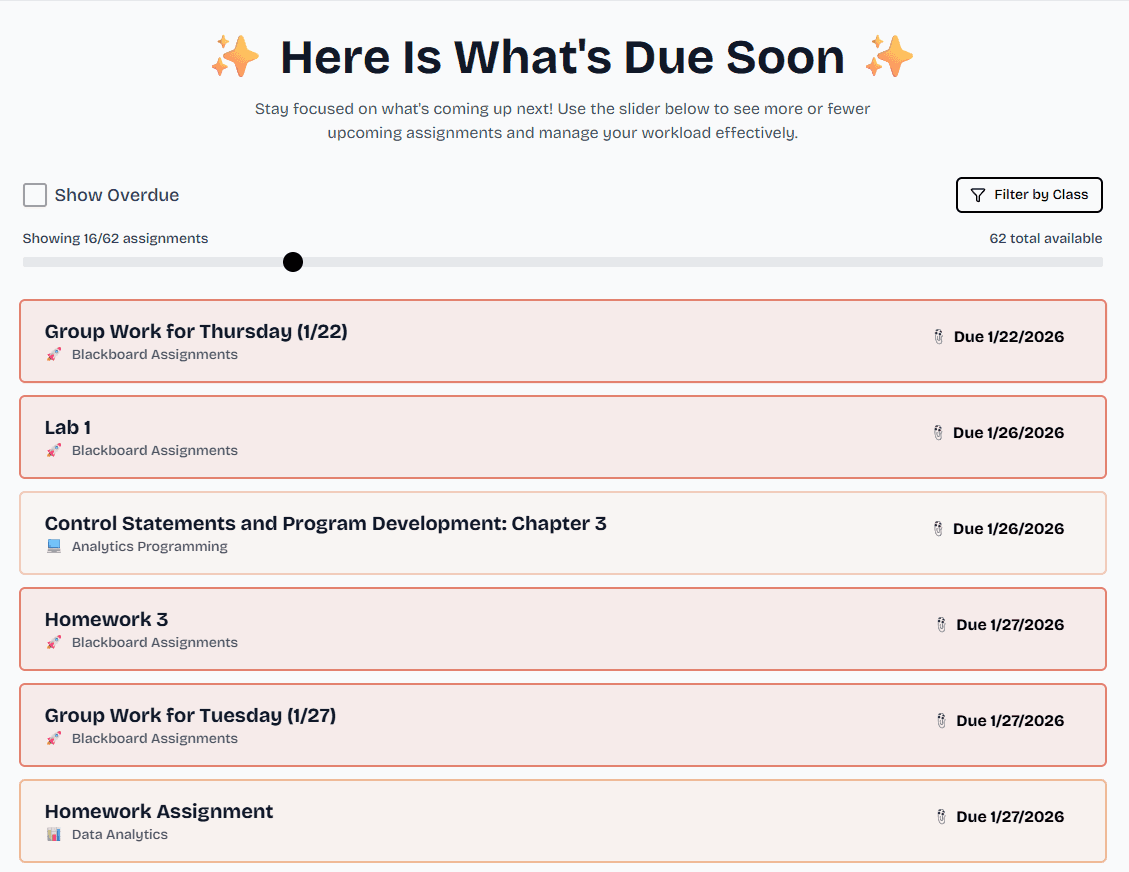
A single calendar view of all upcoming assignments — synced automatically from your syllabus and LMS.
Use a system that tracks deadlines for you
Due Gooder is built specifically for college coursework. Once you upload your syllabus or sync your LMS, it automatically creates a complete view of your semester.
You’ll get:
iOS reminders when class is about to begin
Alerts when assignments are due, and repeated reminders if they’re not marked complete
A Due Soon dashboard showing all upcoming and overdue work
Daily checklists so nothing gets forgotten
A calendar view with Google Calendar sync, so deadlines live where you already plan your day
The biggest difference? You don’t have to remember to check anything. The system checks for you.
Break large tasks into smaller steps
Big projects become less overwhelming when you split them into smaller tasks. List every step from research to revision [17]. Even the scariest projects feel doable when broken into 15-minute chunks [18]. This approach improves your work quality and reduces stress [1].
Create a weekly review habit
Make weekly planning a regular part of your routine. David Allen's weekly review has three parts: get clear (handle loose ends), get current (update tasks), and get creative (think of improvements) [19]. Pick one day—maybe Sunday—as your planning day to set up the week ahead [2].
Conclusion
Missing assignments doesn’t mean you’re bad at college, it usually means your system is working against you.
When deadlines live in too many places, even one busy week can knock everything off track. The fix isn’t trying harder, it’s using a system designed for how college actually works.
If you want a simple way to see every assignment, get reminders before things are due, and stop falling behind, Due Gooder was built for exactly that.
Try Due Gooder free and stop missing assignments.
References
[1] - https://www.beyondbooksmart.com/executive-functioning-strategies-blog/how-to-break-big-tasks-down-into-smaller-steps-to-avoid-overwhelm
[2] - https://www.herzing.edu/blog/how-stay-top-your-assignments-college
[3] - https://www.petersons.com/blog/deadline-management-how-to-stay-on-top-of-your-college-assignments/
[4] - https://blogs.kent.ac.uk/staff-student-news/2024/10/29/managing-academic-deadlines/
[5] - https://cat.wfu.edu/2021/01/the-workload-dilemma/
[6] - https://www.insidehighered.com/news/students/academics/2024/10/30/study-shows-link-between-mental-health-and-academics
[7] - https://www.sciencedirect.com/science/article/pii/S0001691824002282
[8] - https://penmenpress.com/2023/01/15/how-to-communicate-with-professors/
[9] - https://www.luther.edu/inside-college-admissions/post/the-importance-of-using-and-maintaining-a-calendar-for-college
[10] - https://blog.collegevine.com/how-using-a-planner-or-calendar-can-make-your-life-easier
[11] - https://schoolhabits.com/what-to-do-when-youre-overwhelmed-with-late-assignments/
[15] - https://nces.ed.gov/pubs2009/attendancedata/chapter1a.asp
[16] - https://guidetoteaching.newschool.org/why-attendance-matters/
[17] - https://peaklearningsolutions.com/blog/13864/Managing-Long-Term-Assignments-Breaking-Down-Big-Projects-into-Manageable-Tasks
[18] - https://www.absolutelystudying.com/how-to-break-down-large-assignments
[19] - https://www.todoist.com/productivity-methods/weekly-review